
Melissa Borgerding is a playwright and professional writer from Baltimore. Her play Little Ghosts will be presented as a staged reading on Saturday, May 9. It will be directed by Charmaine Chester.
BPF Board Advisor Larry Lambert connected with Melissa to discuss what prompted her to write this play and what has driven her playwriting choices.
L – What prompted you write Little Ghosts?
M– Little Ghosts was inspired by a few memorable family celebrations over the years when events didn’t go exactly as planned, but also by classic locked-room mysteries by writers like Agatha Christie and John Dickson Carr. While Little Ghosts is about as far as you can get from a murder mystery, it draws on similar themes and motifs: an uninvited guest, a closely guarded secret, and a claustrophobic setting where unresolved tensions boil over. It seemed to me that a “locked room” like the event hall in Little Ghosts was the perfect—and possibly the only place—where a family as stoic and self-controlled as the Gardeners could confront their ghosts.
L – One of our sources states that your work explores themes of intergenerational conflict, memory, and the complicated dynamics within families. Is there something in particular that led you to choose this theme?
M – I’m endlessly fascinated by family dynamics. It’s such a rich and deep well to draw from. I was fortunate to grow up with extended family, grandparents, and even a great-grandparent. That’s a lot of opportunity for joy and celebration between generations, but also for misunderstandings, miscommunications, grievances, grudges, and perceived slights—all building on top of one another, layer by layer, over the years. For the three siblings in Little Ghosts, the family dynamic in which they grew up continues to echo well into adulthood, driving their paths in life.
L – How did you enter the realm of play writing?
M – As a kid, I acted in community and dinner theater here in the Baltimore area and continued through college, so I guess you could say theater has always been a background hum in my life. Eventually, I decided to pursue an MFA in Creative Writing, but even then, I was still writing short sketches, scenes, and monologues for my acting friends. It started out as a favor, just something to do for fun, but I eventually discovered that I love writing dialogue. Play writing felt like a natural fit for me—the best of both worlds!
L – What was the first of your plays to be performed?
M – I wrote my first full-length play, Someone Close to You, more than ten years ago. Like Little Ghosts, it’s a family dramedy that explores memory and forgiveness. Ben, a buttoned-up middle manager from Boston, travels to rural New Mexico to convince his fiercely independent, former flower child mother to seek conventional medical intervention for her stage four cancer. Ultimately, the play is about how the love we have for the people closest to us can blind us to who they are and what they really need from us.
I was excited when Someone Close to You was selected for a reading with Baltimore Playwrights Festival way back in 2013 and, more recently, on the West Coast with Theatre West in LA. Someone Close to You is currently under option.
L – Once again, one of our sources states that you have nearly 20 years of experience in the marketing and advertising space, including as a copywriter, creating print, digital, and video content. Do you find significant differences in how you approach that type of writing versus play writing?
M – Copywriting is much easier and more straightforward than play writing! If you’re writing a TV spot, you know you have under 30 seconds to say everything you need to say. If you’re writing a print ad, you know exactly when it’s due and how many words you can use. Without those parameters, play writing—or any kind of creative writing—can feel overwhelming to me. I definitely struggle with blank page syndrome.
That said, I try to apply my advertising background to my play writing, giving myself a self-imposed deadline and seeking out lots of feedback. During the editing process, I’m pretty brutal about cutting as many words as possible to allow the spaces and the silences to do the talking.
L – What would you like the audience to take away from Little Ghosts?
M –Little Ghosts is a play about complicated and flawed people who, for their own individual reasons, feel stuck. We all have little ghosts that haunt us and hold us back. Only by confronting those ghosts can we free ourselves to forgive, let go, and move forward.
L – What’s next on your creative journey?
M – I’m currently taking a break from play writing to work on a fiction project. But considering how much I love play writing and theater in general; I have a feeling it’ll be a short break!
L – Last question: where do you do the bulk of your creative writing?
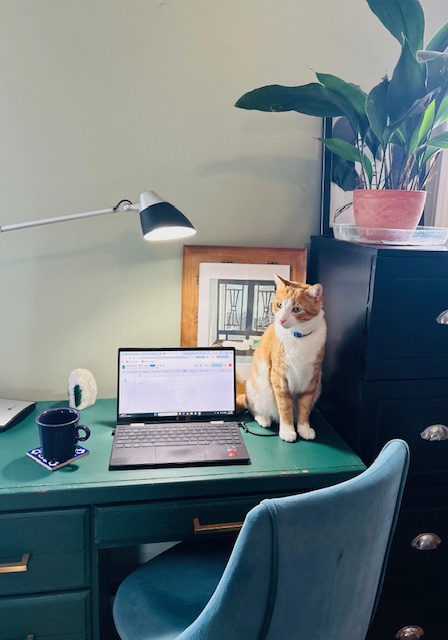
M –Believe it or not, I’ve been working at the same desk I’ve had since I was a kid. It’s the same desk where I did my math homework and wrote terrible poetry. Since then, it’s traveled with me to multiple states and lived in multiple homes and apartments. Every few years, I refurbish it, swapping out the hardware and paint color. At the moment, it’s a dark, moody green called “Fairytale Forest. I think it’s been conducive to writing Little Ghosts, but I may have to switch things up and try out a new color before I start my next play.