
Jerry Slaff returns to Baltimore Playwrights Festival with his play Who’s Yehoodi?. It will be a staged reading, directed by BPF Vice Chair Miriam Bezansky, on Saturday, April 18.
Jerry responded to a series of questions posed by BPF Board Advisor Larry Lambert to discuss his literary career, his inspiration and creative direction.
L – What is the premise for your play Who’s Yehoodi?.
J – The play examines the challenges of two similar Jewish couples on the Lower East Side: one in the early 20th century, the other today. In fact, they’re in the same apartment at the same time, but they don’t know it. There’s time jumping, quantum mechanics and string theory involved — I’m channeling my inner Tom Stoppard.
L – What made you choose this subject for your play?
J – I was in the Lower East Side a few years ago, and I noticed the hipsters and Hasidim dressed alike–black hats and long black coats. That gave me the idea for the two couples occupying the same space at the same time, with the same challenges all young couples have–work, starting a family, and here, finding their way in life when one of them is an “other” for that time. The woman in the modern-day couple is a Jew of Color, and in the 1900s immigrant couple, she’s Sephardic, with ancestors from the Caribbean and South America, when the vast majority were from Europe.
L – There was a phrase “Who’s Yehoodi?” that originated when Jewish violinist Yehudi Menuhin was a guest on the popular radio program The Pepsodent show in the 1930’s. Are there any links to that phrase in your play?
J – Yes, it does! I mention that story, as well as the Cab Calloway song and the thought that “Who’s Yehoodi?” — meaning Who’s Jewish? — was very much in the public eye with the Hollywood Red Scare and the McCarthy hearings targeting left-wing politics.
L – Were you addressing a particular occurrence when you wrote this play?
J – What’s called the “inciting incident” in the play—a twist I won’t go into here—isn’t uncommon in old apartment buildings. You’ll understand when you see it!
L – You write extensively about the Jewish experience. Are you writing at any level about your own experiences in the culture?
J – All writing is, to some extent, autobiography. You put your characters into situations and figure out how they would react. You can’t help but be somewhere in there yourself. Also, my wife is an ordained Reform Cantor, and I tell her everyday, she’s my muse!
L – What do you want the audience to come away with after watching Who’s Yehoodi?
J – That in spite of all the horrors we’re experiencing, there’s still some mystery and fundamental goodness in the world, if we look for it. The world has lived through war, through mad kings and dictators, and we’ve come out the other side. Not to say we don’t have to work to make it better for all of us, of course.
L – Is there a theme that you have not tackled that you would like to explore?
J – I don’t so much look for themes as I do stories, which later suggest a theme to me. I’ve described it as being a radio, set to a specific frequency. Sometimes there’s nothing broadcasting, and other times a story presents itself, and you recognize it. But I’ve become more selective. Writing a play takes six months to a year, and a novel two to three years. It’s a big investment of time, sitting in front of my computer, and I want to make it worth it. I’ve got a super idea for a second novel, based slightly on my early days in the theater and punk scenes in the East Village, and the row house where I lived in an old Italian section of Brooklyn Heights right out of college. It’s definitely worth the next two years, but I can also sneak in a play idea I have in odd moments.
L – You mentioned before that you were going to start writing a book. How’s that going?
J – I’ve finished the first draft and am now editing it; that’s where the real work is. Writing prose uses a totally different muscle than playwriting. First, length. My first draft was 92,000 words (and shrinking as I edit!) while the longest play I’ve ever written was 20,000 words. The novel has nine chapters, essentially nine separate but interconnected stories that could be nine short plays, or nine episodes of a TV series. It’s a lot of work. It took me 2½ years, although I started the first chapter 25 years ago as a short story. I quickly found my style, which is conversational. I want the reader to hear the novel in their head as they read it. I grew up in New York listening to Jean Shepherd and Garrison Keillor on the radio, both superb storytellers and writers. I’m also a huge fan of the British broadcaster and writer Danny Baker. I’ve been surrounded by verbal storytelling my whole life, which might explain my facility with dialogue in my plays as well.
L – Last question: where do you do the bulk of your creative writing and why?
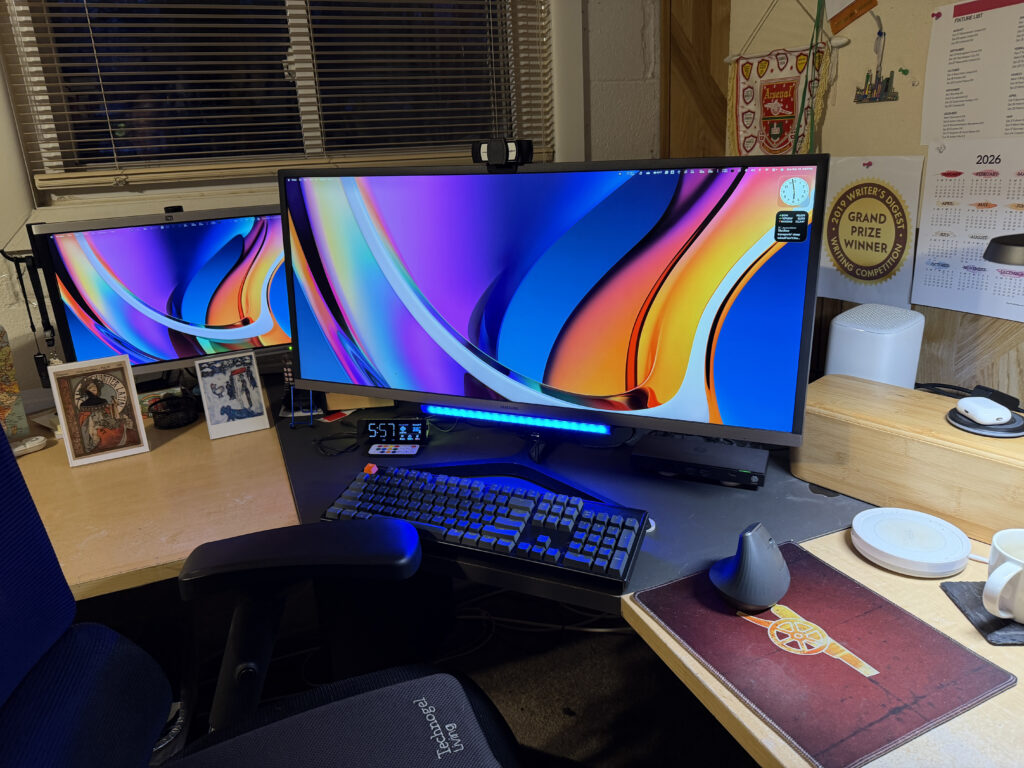
J – I’ve got a big corner desk in our downstairs basement office, with a big screen connected to my Macbook Pro and a window that looks out on my backyard. I’m also surrounded by a lot of momentos from our travels around me–postcards of art by Chagall and Mucha, a replica of the Flamsbana train my wife and I took last year in Norway, a plaque from Emirates Stadium in London where my beloved Arsenal play, and my prized possession, a marionette of a Hasidic rabbi I brought home from Prague. And for those interested, I use Final Draft for playwriting and Word for my novels.