
Elliott Kashner is a playwright, and fundraiser. He is also a Helen Hayes-nominated actor and a member of the Actors’ Equity Association. Elliott’s play The Inn will be presented as a staged reading on Saturday, March 14. It will be directed by Megan Behm.
BPF Board Advisor Larry Lambert connected with Elliott to discuss his career, his primary writing influences and how his acting and playwriting interact.
L – What was your inspiration for writing The Inn?
E – I was working as a fight supernumerary for the Washington National Opera and thinking about how more shows need sword fighting and swashbuckling. At the same time, I happened to be reading “The Witcher”. Geralt is much more of a detective in the source material, much like Batman. In one of the books, Geralt has to deal with a Doppler, a kind of mimic, and one of the scenes happens in a tavern. So that’s where I got the idea for a more locked-in style monster mystery, and I shoehorned some sword fighting in, because plays need more sword fighting.
L – You have a degree in economics and spent several years in the finance world. Why the jump to acting and play writing?
E – I mostly finished my major a year early, but I still needed to finish my elective credits, plus I still had a year left on my scholarship. So, I spent my last year of college doing an independent study and taking classes that I found interesting, including some acting classes. After graduating, while working in finance, I was able to pick up the odd role in the occasional play. Somehow, I ended up stage managing one of Keegan Theatre’s Ireland tours. While I was an awful stage manager, it gave me my first real experience into how expansive the world of theater was, and while I wasn’t quite sure if it was the world for me, I knew that finance wasn’t. Honestly, I still don’t know if theatre is where I belong, but for now, I feel like there’s a lot I want to say, and the stage feels like a good place to say it.
L – When did you make the move to play writing?
E – During the pandemic. I was fundraising for Everyman Theatre at the time (still am), so I still had some connection to theatre as an industry, but I wasn’t working on any shows. I had written a lot when I was younger; for example, I wrote and published a novel when I was 18 and had taken some writing classes in college. The thing about writing is that you can do it on your time, on your schedule, so it felt like the best way to create even while the industry was generally dark. I used my employee discount at Everyman to take a play writing class, where I wrote Dispatched, which was in the Festival two years ago. And I’ve got more ideas than time, so I’ve just kept writing since then.
L – You are a member of Actors’ Equity. Do you have a preference for Equity productions or community-centric theater?
E – Because grant writing pays the bills, and I don’t feel that driving urge to always be working on a show, so I can mostly pick up whatever I find interesting. Joining equity has definitely limited those options, especially as I feel that some of the most interesting and challenging work is being done at the non-equity level. As an actor, your agency is fairly binary: you accept the role or you don’t. But I’ve found a lot more creative freedom as a writer, because you can do it outside the permission structures of the industry. Granted, you still need a company to produce your work, but you don’t need anyone’s permission to write.
L – One of your acting credits is Nightfall with Edgar Allan Poe at the DC Arts Center. Since Poe is so closely associated with Baltimore have you ever thought about trying to mount that production here?
E – I loved that show. It was produced by Molotov Theatre Group, an indie Grand Guignol company born out of the DC Fringe Festival. I was a company member with them for a couple years. Our work was very stylized, inspired by the techniques and traditions of the old French horror theatre, which I have also come to use in my writing. Molotov actually turned into the National Edgar Allan Poe Theatre after the Artistic Director Alex Zavistovich moved up to Baltimore. I’d love to work with them again someday, either if they are eventually able to hire equity or if I give up my card, whichever happens first. Especially on a Nightfall remount, because that show sold out nearly before we even opened. In the meantime, folks should definitely check them out.
L – You work with local theater groups to raise funds. What is your take on the number of groups that are in a position to provide grant money for operations?
E – These are really dark times for fundraising, especially grantmaking. The NEA is under constant threat, so that even keeping them funded is a victory, forget about pushing for more federal arts funding. Meanwhile, with federal cuts to other social services, it pits more nonprofits against each other for fewer dollars. Plus, Maryland was hit the hardest with DOGE, since it has the most federal employees per capita besides DC, so there go a lot of ticket buyers and donors. Many family foundations are experiencing a generational transition, but the kids have since moved out of Baltimore, so we’re seeing a lot of those foundations either spend down or move elsewhere. Meanwhile, I’ve been running into more funders that explicitly do not fund arts and culture, some even have written the prohibition into their charters. It’s a dire funding scene. On the plus side, the Maryland State Arts Council is still the gold standard for arts funding in my book, and Maryland Citizens for the Arts is doing fantastic work.
L – You work with a number of local theater companies. How do you keep it all straight?
E – I write myself a status report every week. I write down everything I accomplished last week, what I need to do this week, and what’s coming up over the next two months. I’ve done this every week for the past ten years. I literally have hundreds of reports sitting in my drive.
L – Have you developed a preference between acting and play writing?
E – Acting is definitely more immediately gratifying. You are in the rehearsal room, actively collaborating with your director and other actors. You are building those relationships every day. You get immediate feedback from the audience. You get to walk out into the lobby and say hi to people after the show, if you want to. You get to put the show in your body and walk around with it. But only if someone casts you. And every once in a while, you find a theater that is doing a show that really speaks to the kinds of things you want to say as an artist, and the play has a role that is down the middle right for you. And then they cast someone else, and you have to find what else to do with energy. So, you write. And it’s excruciating. Every word drips out of your fingers like droplets of blood falling slowly onto the page. But no one gets to tell you no.
L – What about a favorite type of subject to write about?
E – I have been, and will continue to be, primarily focused on horror. I learned this concept called “recreational fear,” about the emotional, psychological, and social benefits of not only being afraid, but being afraid when you are with other people. Especially when you can experience all that in a safe environment. However, in my humble opinion, there is not nearly enough horror in theatre. I think one reason horror has flourished in other media more than in theatre is that theatre is limited by physical possibility in a way that is less restricting in other media. And the audience knows a play cannot do anything physically impossible. However, more things are possible on stage than we let ourselves believe, so horror theatre benefits more than other media from surprising audiences’ expectations. Kind of like magic.
L – Do you have anything in the pipeline as part of your creative efforts?
E – Too many things. I just finished my take on The King in Yellow, a running motif throughout the work of American gothic and cosmic horror authors like Ambrose Bierce, Robert W. Chambers, and HP Lovecraft. I’m hoping to find a workshop for it, because the challenge of cosmic horror is to tell a story about forces beyond human comprehension, but you still need to tell a narratively satisfying story. I’m also in the early stages of a play about the summer that Mary Shelley, Percy Shelley, and Lord Byron spent in Villa Diodati and held their famous contest.
L – This may be sticky – you have performed at the Kennedy Center in DC. Do you have an opinion about the most recent changes to that institution?
E – I left right before the takeover, but the writing was already on the wall that there was a culture change happening, not with the theatre or its staff, but with the audiences. I think the Lab is just shy of 400 seats. And I would look out into the audience during the show, and see 200 red hats. Shear Madness has political jokes, but they’re all fairly mild and make fun of both sides. However, if MAGA were in the audience and didn’t like a joke, they let you know. Teenagers in red hats would try to bring Trump flags onto the stage. There was a vibe of “We won, and this place is ours now.”
L – Last question: where do you do the bulk of your creative writing and why?
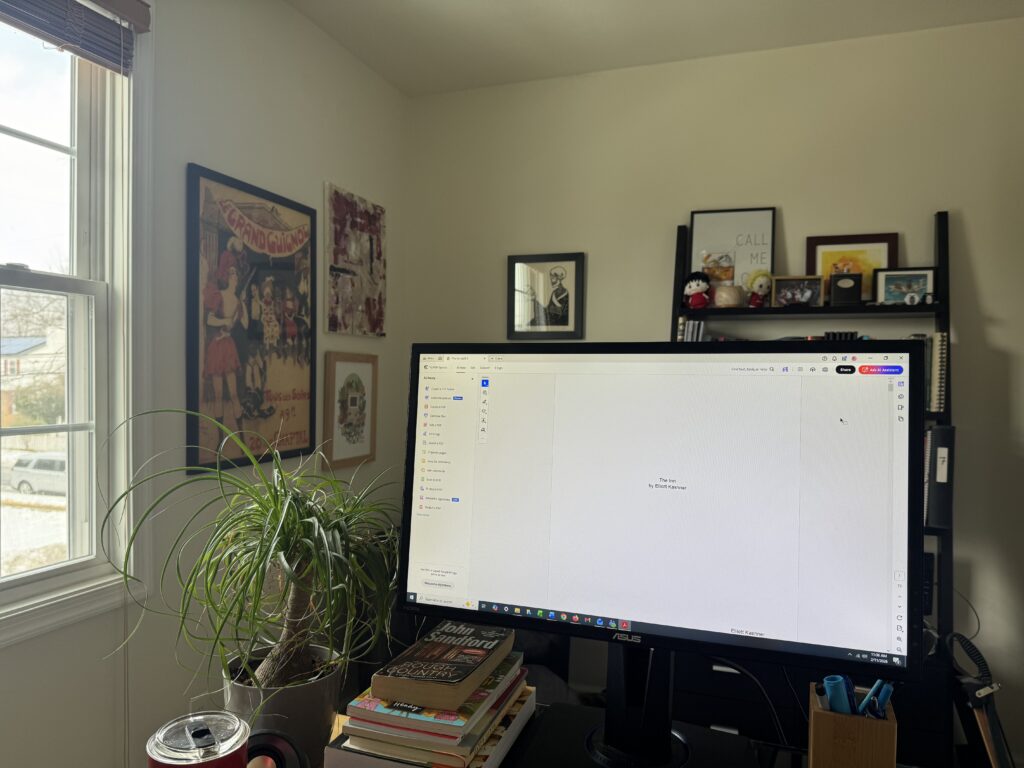
E – My office, in my home in Laurel, Maryland.