
Kerr Lockhart brings to BPF experience as an attorney, actor, director, writer and music director, among other endeavors. He has returned to BPF with his play These Little Piggies, which will be presented as a staged reading on Thursday, May 14. It will be directed by Andre Tittle.
BPF Board Advisor Larry Lambert connected with Kerr to discuss his multi-faceted career, what his primary influences are and how these pursuits interact.
L – You are returning to BPF, where your play Sanctity received a staged reading. How do you feel about returning with this new play?
K – The BPF really honors playwrights in a number of ways. First, the selection is made not by a set committee or the artistic director’s hand-picked group. The authors of the plays are not identified, and they are read by anonymous readers, presumably mostly playwrights, with a smattering of enthusiastic audience members. And the plays are not put up against each other like a beauty contest. The readers’ responses result in a score which is arrived at objectively, so the playwrights know there can have been no personal bias in the selection. And the BPF makes the readers’ comments available to the playwrights. I don’t read them anymore, but they’re there.
The readings themselves keep the focus on the playwright and the writing. And I have been fortunate enough to be assigned to work with Andre Tittle as director, with whom I have formed an artistic partnership, so the experience has been quite a gift to me.
L – What was your inspiration for writing These Little Piggies?
K – Many plays are the result of two different impulses coming together. In the case of These Little Piggies, I have long wanted to write my own variation on Tartuffe. Rather than adapting an entire play, I like to take the initial premise of a pre-existing work and develop the story in a different direction. I did something similar many years ago with Gogol’s Inspector General, which I transformed into a farce about phony school inspectors.
The second impulse was reading about Elizabeth Holmes and being shocked by the sane, sensible older men like George Schultz, who were completely blind to this woman’s lack of credentials and nonsensical pseudo-science. You don’t want to think it was due to her physical attractiveness, but what else can you think?
So, I thought of Holmes as a Tartuffe and Schultz as an Orgon, but then it occurred to me that you wouldn’t go to Schultz if you were looking for a lot of money, you would go to Elon Musk. And that idea seemed like so much fun, that Tartuffe went out the window, and we were off to the races.
L – How long has this play been in development?
K – I am founder and facilitator of the Frederick Playwrights Circle, which meets twice a month to share works in progress. (You may obtain more details by writing to fredplaywrights@gmail.com or by visiting us on Facebook.) In the first season, last year, I felt an inherent pressure to show up at each meeting with fresh pages. So I wrote the play, scene by scene from September 2024 through May 2025. There’s been some polishing and refinement since then, but nothing substantial.
L – After getting your JD you worked as a business affairs attorney for some pretty big outfits – William Morris Agency, Hallmark Entertainment and CNBC/MSNBC – among others. After some 20 years in that world became a high school teacher. That’s a really significant jump. Why did you make that change?
K – Due to an old dream and a terrible, if understandable mistake. The first was what I went to undergraduate with the desire to be a music teacher. The other was the notion that, after a career of serving other people’s agendas, I could build something of my own as a classroom teacher. That notion is outdated. School administrations script and guide every part of your lessons, and while there are many rewards in teaching, independence and self-determination is not one, at least not in New Jersey, where I lived and worked at the time.
L – During your time before teaching you were a producer in independent television and film. Did you feel like that might be a new direction to explore?
K – Yes, but not in the documentary mode that marked my earlier career. I am very interested in writing and producing scripted work for film and television based in Baltimore. Homicide and The Wire left a solid infrastructure here, and there is talent and money, including incentives, to amply support production here. Andre Tittle and I are already working together on a script.
L – When did you start writing plays?
K – My first full length was in college, a thesis play written to disprove Brecht’s hypothesis that if you write in the Epic mode as he defined it, the result would be a socialist or communist work. I adapted The Good Soldier Schweick. The response was great, and I knew I had technical ability, but I didn’t have subjects that burned to be written. There was a lot of sketch writing and incidental things. Then, when I turned 60 and could see retirement over the horizon, I decided to make playwriting my principal avocation. The first play I wrote after that resolution got a staged reading with a Drama Desk Award winner, so I guess it was a good decision. I now have several pages of lists of one-line story ideas.
L – You wrote The School Inspectors expressly for students. Did you find writing for this audience different than writing for adults? In what ways?
K – Other than the setting, which shifted Gogol’s Inspector General into a contemporary high school, I didn’t think about the audience. I wrote for my student actors, what they were capable of doing well and what they enjoyed doing. And that is like any time when you write with certain actors in mind. (PS, those actors are almost never available.)
L – A lawyer needs to present information to their audience, as does a playwright. Are there any similarities in the way the information is presented?
K – I never had a trial practice, so I never had to do that kind of formal storytelling. I was a negotiator and contract draftsman. Mike Nichols said every scene is a seduction, a fight, or a negotiation, so I guess I’ve got a third of that down. (Actually, deal making involves seduction as well, so there’s two-thirds.)
L – Is there any person or writer that has influenced your writing style?
K – Billy Wilder and I.A.L. Diamond for character and the music of dialogue, Shakespeare for pace and structure, Brecht and Stoppard for the way to dramatize ideas, Shaw for how to present conflict without violence.
L – What do you want this audience to take away from this presentation?
K – First and foremost, the memory of laughter. Second, the notion that while capitalism has an organic quality, it lacks humanity. It’s a poor substitute for genuine community.
L – What’s next on your creative journey?
K – We are working on a production of Sanctity in Frederick in August.
I also have two new plays going now. One is about the last graduation ceremony of a one-room schoolhouse, and includes a one-woman pageant of American women in history. The other is about an African-American woman and a South Asian man who are both first-year associates at a white shoe law firm, and how they learn to manage expectations, both of their employers and their own. There’s a one-act play as well, part of a trilogy about consent, called “Getting To No.” But that’s pretty far on the back burner. Before the end of the year I hope to start a play called “How Not To Get Into College” which is my first play for student-age actors in almost a decade. It’s based on a very funny college essay by my daughter.
L – Last question: where do you do the bulk of your creative writing and why?
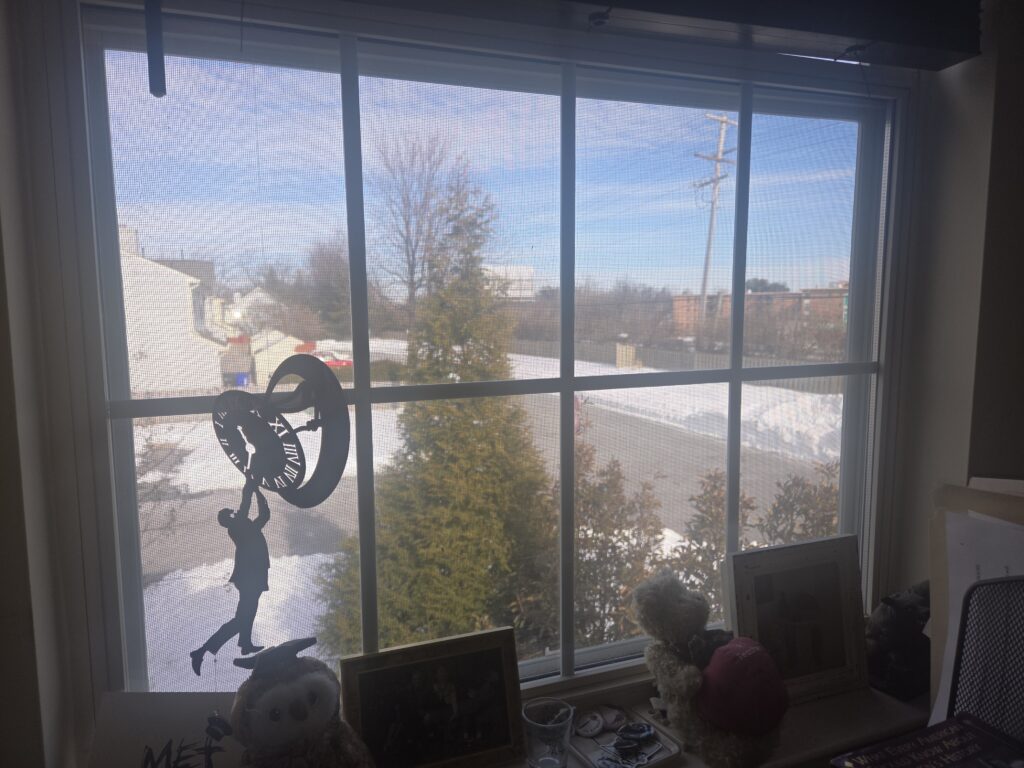
K – I have had the same unpolished wooden desk for nearly twenty years, which sits in my office where I like to cocoon myself with my books and a few hundred DVDs (no viewing allowed until 4 PM). I’m afraid I lack the ability to concentrate that would be needed to work in a coffee shop or a shared space. This picture shows the view from my window which looks out on Route 15, which is far less disturbing than you would think.