
Greg Jones Ellis has been a performer, creative, director, dramaturg and playwright among other areas in the creative sphere. A multi-award winner, Greg’s play Vera, Chuck and Dave will grace our stage, directed by Darren McGregor, on Saturday, February 28.
BPF Board Advisor Larry Lambert connected with Greg to discuss his wide-ranging interests, his writing and why he chose this subject.
L – You are listed in various source as performer, creative, director, dramaturg, and playwright. Is there anything in the creative sphere that you haven’t tried?
G – I wouldn’t touch design, although when directing I’ve loved meeting with designers and collaborating on a unified approach to the look and sound of a show. But I rely on–and am in awe of–designers.
L – Adding the amount of voiceover work you have done, along with teaching experience, do you have a favorite aspect of the creative world?
G – I love whatever takes me totally away from my day to day, when I pick my head up and realize hours have merrily passed by and I never noticed. That generally happens with three activities: rehearsing (whether as actor, director or playwright, I never want to leave rehearsal), research (including prepping for the class I teach called “8 Plays Everyone Should Know”) or performing onstage in a really good production. The real world just melts away for a while.
L – When did you start playwriting? What was your first experience with this area?
G – I actually wrote a children’s play in college when I taught little kids as a day camp counselor. I wanted each kid to have an equal part. It was called The Witch, The Wizard and the Wish. Suffice it to say it didn’t enter the pantheon of children’s lit, but it fit the bill.
In New York my first collaboration was writing book and lyrics for a musical version of Feydeau’s A Flea in Her Ear. Sadly, my collaborator was a brilliant rising musician named Michael Lee Stockler who was a victim of the AIDS epidemic. However, before we lost Michael he and I were hired by Bob Moss of Playwrights Horizons to write an industrial musical for a restaurant chain. So much fun, and you could say it was the first time I actually saw and heard my work. I wrote songs for singing fish filets! And they paid me! Heaven.
My first published comedy, Divinity Place started in the 1990s. I had a wonderful mentor who got a reading of it at HBO, then many readings later it finally got produced and published. Long time between the germ of an idea and the final version.
L – You have various scripts that have received awards from West Hollywood to Montgomery County. Does any one particular award stand out to you?
G – Two for different reasons. The Julie Harris award from the Beverly Hills Theatre Guild reassured me that my play All Save One, which is set in Hollywood, felt authentic to those who live there. The Dominion Stage Best Play award for my play Dead Air has led to an upcoming full production. And let’s face it, a play isn’t really a play until it’s produced, right?
L – Your first play, Divinity Place, is a comedy inspired by your parents’ fraught wedding on the eve of World War II. What did you learn about writing about your parents?
G – This was based on one of my favorite true stories that my parents would tell. I couldn’t get enough. It had everything: both families disapproving, a jealous sister, a wedding dress that wouldn’t quite stay on, the pressure of a looming war. But if you knew my parents you knew that my mother was a tough cookie (owing to having grown up in a Catholic orphanage) and my dad was this innocent raised in a strict home with an atheist father). Once I decided this was a farce, I really thought about what made their romance the center of the crazy, bigoted storm surrounding them. I realized that she gave him courage and he gave her safe haven. And that’s what they both gave me.
L – What made you write Vera, Chuck and Dave? Given your history it seems like you could have lived in a situation like this one.
G – Oh, you bet! Hasn’t every theatre artist? Like my characters, I love to hang out with fellow actors, directors, etc. and recount all the wild backstage and onstage moments. In fact, my original title for Vera Chuck and Dave was “Reminds Me of a Story.”
My own favorite personal stories include having to scuttle a new actor in a long running show offstage because the director forgot to rehearse the poor guy for a number and as the rest of us started singing and dancing, he looked stricken. I had to stay in character, wave at him and then dance him into the wings. Or being flipped over onto a glass coffee table during a fight scene and playing the rest of it as my, shall we say, derriere gradually became visibly red – and not with stage blood but the real McCoy. And I could go on but the stories are better over a few cocktails! Just name the bar and I’ll be there.
L – What would you like our audience to take away from play?
G – Despite all the rueful reenactments of past flops and triumphs and the tough adjustments these three old pros have had to make as show business continues to evolve, they’re ultimately up for reinventing themselves one more time to stay in the game. That’s my hope for everyone who finds the present tough to adjust to, whether it’s show business or the wider world: our best future is to take life as it is and push forward.
L – What’s next on your creative journey?
G – After thinking I didn’t have a new play in me, I’m suddenly revisiting a notion about a fictional encounter between Truman Capote and Marcel Proust. And, of course, I’m very much looking forward to Dead Air‘s premiere. I’m also always eager to get back onstage but, like Vera and the boys, I find the opportunities slimmer. And I have to say, I’ve been so lucky in these past few years to have been given several incredibly rich roles. I can wait till another good one rolls my way.
L – Last question: where do you do the bulk of your creative writing and why? (Love the muse, by the way.)
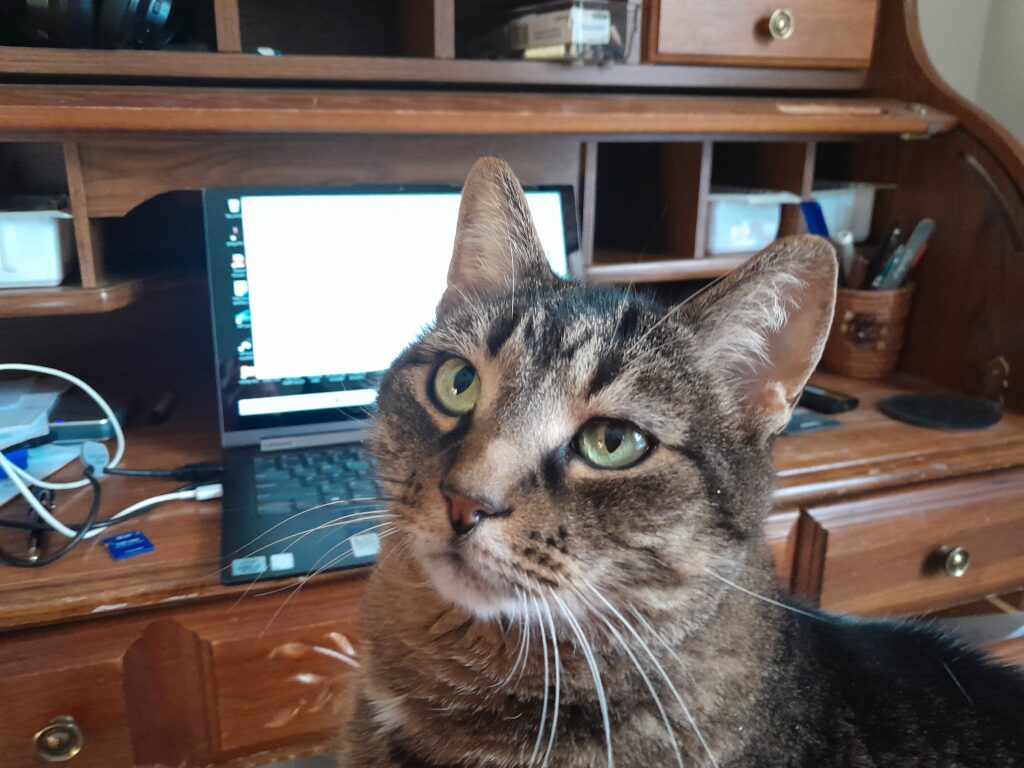
G – I really do sit at my desk with my “muse” (Leo or, since recent events in Rome, is called His Holiness) on my lap and tap away. But, and most writers will agree, I think, that this is really “transcribing” what you have been working through in your head for weeks, months, years. I worked out the plot points to All Save One while swimming every day. And the play’s final resolution monologue eluded me until I (true story) sat my cat on my lap and said out loud to him everything I thought the character would say. I finished, he looked me in the eye and licked my nose. And I knew I had licked the problem, too!