
Stephen LaRocque is a prolific actor, writer and director with almost 50 years of experience. His third Baltimore Playwrights Festival submission, Declaration, directed by BPF’s own Miriam Bazensky, will be staged on Saturday, February 28.
BPF Board Advisor Larry Lambert connected with Steve to discuss the play, his writing and his future plans.
L – This is your third accepted submission to BPF. A previous one, $40 Million, If You Want It was directed by well-known Baltimore director Barry Feinstein in 2005. Does this feel like a bit of a homecoming?
S – Absolutely! I look forward to seeing Barry, Miriam Bazensky (who is directing Declaration), and Kathleen Barber – all of whom I remember from the 2005 Festival.
L – Declaration has a very interesting premise. What made you choose to highlight the selection of Mary Katharine Goddard, a Baltimore printer and newspaper publisher, to produce the first public version of the Declaration of Independence with the names of the signers?
S – I liked the idea of Mary Katharine Goddard as an obscure historical figure (there is no biography of her, not even a portrait that is indisputably acknowledged to be her likeness), printing a significant version of the document, commissioned by the great men who packed up and went back to Philadelphia scarcely a month after it was printed. The great men come, they do great things, they go back, and life goes on. Her obscurity was actually an asset: I could imagine her more freely than I could a fully documented historical character. I often thought of Bertold Brecht’s character, Mother Courage – a woman who keeps things going, no matter what, but I also wanted her to be an adventurous thinker and an articulate advocate for her views.
L – How long did it take you to research and create this play? Were there any surprises during the process?
S – Looking at the date stamps on my hard drive, I see that I downloaded my first research article (Franz, Anna, “Evidence of Women: Women as Printers, Donors, and Owners of Law Texts,” American Law, Book 11, 2015) on July 30, 2017; so the research began about eight and a half years ago.
About the writing, I’m not as certain, because I usually start with a notebook (with no dates), then type the handwritten lines into a spreadsheet, which I use to move the text around, time the lines, etc., and then convert the lines into the Dramatists Guild format and paste them into word processing software to make the PDF file. My first spreadsheet entry is November 11, 2019, so I spent at least six years writing the script.
Surprises? Oh, yes. Looking at the initial list of characters in my notebook, I see that I had originally planned for eight characters (four men, four women). I ended up dropping four of the original eight and adding one (John Adams) who wasn’t in the original scheme. The biggest decision was to drop a subplot about Goddard’s slave (she actually owned at least one, possibly as many as three) who works in the print shop, and about her relationship with a free black post rider (there actually were free blacks who delivered the mail for the British before Mary Katharine’s brother set up the Continental system). But it would have been one story too many, so I followed the famous dictum of the novelist G.K. Chesterton, “Kill your darlings.”
L – When did you start your writing career?
S – I submitted my first script (and got my first rejection letter) in 1976 – 50 years ago, come June. I have been submitting – and getting rejected – pretty regularly ever since. I wish I had kept all the rejection letters that I got in the intervening years; it would have been a nice collection of theater stationery. It hasn’t been all rejection, though: I’ve had three full-length and about 13 one-act plays produced, plus two one-person shows and several scripts for skits, sketches, etc.
L – What type of subject matter most makes you want to write about it?
S – I like writing about historical figures, probably because the research exposes me to people, events, and ideas (like the dark vision of society in Hobbes’ Leviathan) that I had never been fully aware of. But I also like romantic comedies where the romance doesn’t come easily, where people fight tooth and nail for their independence and ultimately give in (or not). I submitted one of those (Daylight Saving Time) to the Festival several years ago. It wasn’t selected, but a scene from it was chosen for the Free Fall event that year; it was fun to see the scene on its feet.
L – You have been writing since 1976. In that time, you also spent 29 years on active duty as a Naval officer before retiring. Was there a lot of overlap between the two careers?
S – I put a lot of effort into being a Naval officer, but, as in every profession, there is un-spoken-for time; that’s what I used to write. I wrote so many scripts commuting back and forth from the Pentagon on the Metro trains; I wish I had dated the pages, so I could figure out how much of my life I spent scribbling during the commute. I like to think that I was following in the footsteps of people like Anthony Trollope, who wrote novels while traveling as an inspector for the British Postal System, or A.A. Milne, who began writing plays and stories when he was in the Signal Corps during World War I.
L – You had a play produced on a submarine? That must have been unique.
S – Well, not a play; it was more like a sketch – a parody of an awards ceremony (think the Oscars or Golden Globes), with sendups of certain prominent personalities among the crew. The victims took it in good spirit (as far as I know), and it filled in some of the dead spaces that inevitably occur on a long patrol.
L – You were stationed at the Pentagon when it was hit on September 11, 2001, and subsequently wrote the play September 11th was a Tuesday. You chose to focus on two female civilian workers for this play. What motivated you to make that choice?
S – I worked with women like that in the Pentagon, and I knew the jargon of their trade and the geography of the places where they would have moved. It was really one of the easiest plays I have written in terms of research; all I really had to study was the rehab procedures for burn victims. A lot of the stories in the script are real stories that I heard from Pentagon workers who talked about what happened during the days and weeks after the attack.
L – You mention performing a one-man show highlighting the life of Ernie Pyle, the legendary World War II reporter. Could you describe this show and how it came about?
S – It started when I bought a second-hand book at the Second Story Books Warehouse in Rockville (a dangerous place for anyone who aspires to a simple life). The book, Brave Men, was a compilation of Pyle’s articles from the front in World War II. I was enthralled by the style and power of his writing – simple, understandable, yet capable of great poignancy and impact. I bought all five books of Pyle’s articles, then read, and read, and started editing until I had gotten the material down to just under an hour of performance time. Then I got permission from the foundation that holds the rights to most of his work to use the material that I had selected. I premiered the show as a staged reading in 2011 at the 10th Annual Kennedy Center Page-to-Stage New Play Festival. I then developed it into a fully staged show, with costume, props, and sound cues.
L – How long has it been running?
S – The first fully staged performance took place in November 2012 at the Montgomery College Cultural Arts Center, Silver Spring, MD. So that would make it 13 years plus, minus the COVID time; let’s say 11 years, about forty performances (a lot of them at seniors’ homes and centers). We’re still taking bookings for new gigs. I expect that I’ll keep doing it until the memory gives out, or the legs, or both.
L – Back to Declaration, what would you like your audience to take away from this performance?
S – Don’t take the “United” in the United States of America for granted. Hobbes’ vision of a country successfully defending itself against a common enemy, then tearing itself to pieces with internal hostilities, is ever-present. Also, pay attention to the women. They have always been important contributors, often of necessity, when the men in their lives died off and they had to become the sole provider. If American women had been admitted to the franchise and the full powers of citizenship at the outset, we might have avoided some of the worst episodes in our history.
L – What’s next on your creative journey.
S – There are always scripts to be dug out of the notebooks and whipped into shape, but at present I’m working on a different kind of project: a scheme for coaching actors, singers, and anyone else who needs or wants to learn text verbatim, using statistics; call it “memorization coaching.” I have been astonished at the extent to which statistics have been used in sports – baseball, especially – to inform decision-making by managers and coaching of athletes. I believe that accuracy of verbatim memorization can be measured and evaluated, and the results can be used to help memorizers get to performance level more efficiently.
L – Last question: where do you do the bulk of your creative writing and why?
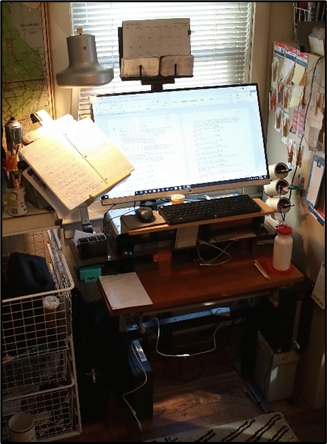
S – Now that I’m no longer riding the D.C. Metro trains daily, I would have to say that my stand-up workspace in my home office is the place where I usually whip things into shape. But I still like to start off with the old-fashioned analog notebook, scribbling away in any possible place, from a park bench to the propped-up pillows in my bed – although, after having seen Trumbo, the film about Dalton Trumbo, the blacklisted screenwriter, I’ve wondered what it would be like to write in a bathtub. The threat of everything getting wet would be a deterrent, but it might be fun to have a go at it, just once.